

















Last Updated on September 9, 2026
Let’s pretend for a moment that you’re an alcoholic. Your wife left you and took the kids with her, your family members don’t really talk to you or associate with you anymore, and your only friends are the bottles of liquor that you keep in your kitchen cabinets.
One day you decided you were tired of being depressed and living a life that you hated so you picked up the phone and enrolled in an alcohol detox program.
How Can Rehab Help Someone Who Keeps Relapsing Over and Over?
Rehab helps people caught in a cycle of chronic relapse by giving them enough time and structure to address the underlying causes driving the relapses — not just the substance use itself. Long-term residential programs (90+ days) are often most effective for repeat relapse, because they allow deeper work on trauma, triggers, and co-occurring issues, build a relapse-prevention plan, and connect the person to ongoing peer support and a continuum of care after treatment ends. Many people need more than one treatment episode, and longer time in treatment is consistently linked to better long-term outcomes.
You completed your detox and spent 30 days in drug rehab before returning to your home. You made it for about six weeks before you cracked and gave in to your cravings for a drink. You convinced yourself it was just a lapse and that it wouldn’t happen again, but the next day, you found yourself at the liquor store replenishing the supply of alcohol that you had emptied from your cabinets several weeks ago.
After six months of heavy drinking and overwhelming shame, you decide to pick yourself up and get back into treatment so you can get sober again—for good this time.
This cycle continues for five years, and before you know it, you’ve completed three different rehab programs and you’ve pledged yourself to a life of sobriety countless times. But it never seems to last.
You’re currently sober and you know the lingo and the tools you learned in rehab like the back of your hand. But despite everything, you still feel the magnetic pull of those liquor bottles in your cabinet and you have a lingering feeling that you’ll be seeing them again soon, regardless of how much you don’t want to.
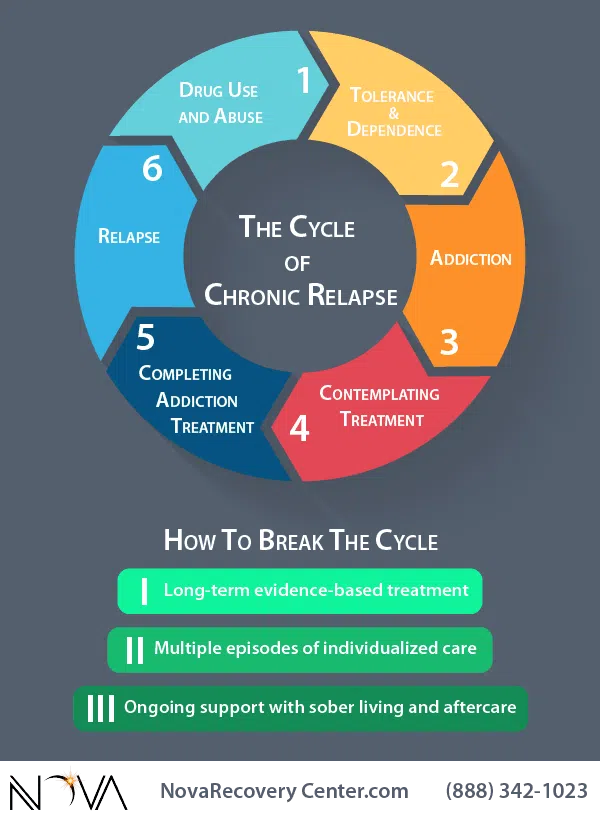
This continuous cycle is known as chronic relapse and it’s much more common than you might think.
Why Do Some People Struggle with Chronic Relapse?

Chronic relapse typically occurs for a variety of reasons, depending on the individual’s circumstances and life experiences. According to Psych Central, there are a number of factors that may be contributors to chronic relapse.1 They typically include:
- Unresolved trauma
- Family conflict
- Major life transitions
- “Transferred” addictions (overeating, shopping, gambling, sex/love, etc.)
- Dishonesty with treatment counselors and peers in drug and alcohol rehab
- Harmful living environment
[sc name=”phoneinsurancecta”]
Signs and Symptoms of Chronic Relapse
There are several telltale signs of chronic relapse, and although every person is different, individuals struggling with chronic relapse often have the following things in common.2
- They have not firmly decided that they want to live a life of sobriety and still have a desire to experience their drug use.
- They have a wealth of knowledge about addiction, recovery, and sobriety, but they are unable to apply it to their own lives, and therefore, are never able to maintain their sobriety.
- They associate sobriety with a constant struggle and feel hopeless as a result.
- They are only completing drug and alcohol rehab programs to make a loved one happy.
- They have had multiple episodes of treatment but usually leave early, get kicked out, or fake their way through it simply to appease a loved one.
- They refuse to face certain issues related to their addiction or lie to counselors.
How to Avoid Relapse: The Impact of Drug and Alcohol Rehab
Breaking the cycle of chronic relapse is not always easy but it can be achieved with the right type and duration of addiction treatment.
Long-Term Drug and Alcohol Rehab
According to a study published by the journal Addiction Science and Clinical Practice, of all the people admitted to public addiction treatment programs in 2003, 64 percent were reentering treatment, 23 percent for the second time, 22 percent for the third or fourth time, and 19 percent for the fifth or more time.3
Although one month in drug and alcohol rehab may keep some people from ever touching drugs or alcohol again, many people need three to four episodes of treatment over a number of years before they can completely overcome their addiction.
Research shows that the best treatment outcomes are a result of longer periods of time spent in treatment.4 Long-term drug and alcohol rehab programs that last 90 days or longer give clients more time to work through the deep-seated issues that have contributed to their addiction and develop healthier ways to cope with stress and triggers.
Long-term drug and alcohol rehab also provides opportunities to establish a peer support network and get involved in a 12-step group. This network of individuals will be crucial to maintaining long-term sobriety.
Looking for treatment for you or a loved one?
Nova Recovery Center can help prevent chronic relapse!
Call (512) 605-2955 today to learn about our outpatient and inpatient options.
Chronic Relapse Prevention Plan
Every person who completes a drug and alcohol rehab program should also have a (chronic) relapse prevention plan. This is simply a written plan that outlines what he or she will do in the event of a lapse.
There are five key components that should be included in any relapse prevention plan. They are:
- Self-assessment and reflection on previous substance use and triggers.
- A list of triggers and specific plans to deal with each of them should they arise.
- A step-by-step plan of action outlining exactly what the client will do if he or she relapses.
- A list of family members, friends, sponsors, and/or counselors that the client can call if he or she feels like a relapse is imminent.
- Goals for a healthy and sober lifestyle.
A relapse prevention plan should be revised often to reflect the client’s current state of mind, address new triggers, and include any new sobriety goals.
Continuum of Care
Continued treatment after drug and alcohol rehab is essential to fighting chronic relapse. The treatment process will look different for every person, but many individuals in recovery choose to continue their treatment plan by enrolling in a sober living program. Transitional homes provide a structured lifestyle, regular drug and alcohol testing, and peer support for individuals who are learning to live a life of sobriety on their own.
People in recovery may also choose to continue treatment by enrolling in an outpatient program, to reinforce the many skills and tools they learned in rehab. IOP can also enhance the benefits of a sober living program.
Continued involvement in self-help groups such as Alcoholics Anonymous or Narcotics Anonymous is also essential to maintaining sobriety and avoiding relapse. Studies show that peer support is a key component to a sustainable life in recovery.5
If you or a loved one is struggling with chronic relapse, Nova Recovery Center can help. We specialize in helping those who are wrestling with the negative effects of chronic relapse and can provide an effective long-term drug and alcohol rehab program that will combat those issues with relapse prevention plans, peer support, and an affordable and customizable continuum of care plan.
Contact Nova Recovery Center today to speak with an admissions specialist about our gender-specific addiction treatment programs for men and women in recovery.
References:
- https://blogs.psychcentral.com/sex/2011/11/chronic-relapse-unresolved-sex-and-love-addiction-may-be-a-contributor/
- https://www.addictionpro.com/article/help-chronic-relapser
- https://www.ncbi.nlm.nih.gov/pmc/articles/PMC2797101/
- https://www.drugabuse.gov/publications/principles-drug-addiction-treatment-research-based-guide-third-edition/principles-effective-treatment
- https://www.ncbi.nlm.nih.gov/pmc/articles/PMC5047716/
FAQ: Chronic Relapse and Rehab
Why do some people keep relapsing over and over?
Chronic relapse usually stems from underlying issues that haven’t been fully addressed — such as unresolved trauma, co-occurring mental health conditions, family conflict, an unstable living environment, or incomplete prior treatment. Without resolving these root causes and building strong coping and relapse-prevention skills, the cycle tends to repeat.
How can rehab help someone who keeps relapsing?
Rehab helps by providing enough time and structure to address the root causes of addiction, not just the substance use. This typically includes longer-term treatment, a written relapse-prevention plan, peer support, and a continuum of care after the program ends. Longer time in treatment is consistently associated with better long-term outcomes for people with a history of relapse.
What type of rehab is best for chronic relapse?
Long-term residential rehab (90 days or more) is often recommended for chronic relapse, because it allows deeper work on the issues driving repeated relapse and more time to build lasting recovery skills. A step-down continuum — such as sober living and outpatient care afterward — helps reinforce those gains and sustain sobriety.
Is it normal to need rehab more than once?
Yes. Addiction is a chronic, relapsing condition, and many people need more than one episode of treatment before achieving lasting recovery. Needing rehab again is not a failure — it’s common, and each episode can build toward long-term success, especially with longer treatment duration and strong aftercare.
How Can Rehab Help Someone Who Keeps Relapsing Over and Over?
Direct answer: Rehab helps chronic relapsers by identifying underlying relapse triggers through comprehensive assessment, adjusting treatment intensity and modalities (such as switching from outpatient to residential care), addressing co-occurring mental health disorders that fuel the cycle, and building longer-term aftercare structures including ongoing therapy, medication-assisted treatment, and recovery monitoring. At Nova Recovery Center, our clinical teams in Austin, Houston, San Antonio, and Colorado Springs specialize in creating individualized relapse-prevention plans that evolve with each person’s needs.
Why Traditional Approaches May Not Have Worked
Repeated relapse often signals that previous treatment didn’t address the root causes. Common gaps include:
- Undiagnosed co-occurring disorders: Anxiety, depression, PTSD, or bipolar disorder can drive substance use when left untreated
- Insufficient treatment duration: Short 28-day programs may not provide enough time to build sustainable coping skills
- Lack of medication-assisted treatment (MAT): For opioid or alcohol dependence, medications like buprenorphine, naltrexone, or acamprosate significantly reduce relapse rates
- Inadequate aftercare planning: Returning to the same environment without structured support increases vulnerability
- Wrong level of care: Outpatient treatment may be insufficient for someone with severe addiction or unstable housing
How Nova Recovery Center Addresses Chronic Relapse
Our approach to treating individuals with relapse histories includes:
Comprehensive clinical assessment: We conduct thorough psychological, medical, and substance use evaluations to identify every factor contributing to relapse—including trauma history, family dynamics, employment stress, and social triggers.
Flexible levels of care: Depending on your situation, we offer residential rehab in Austin and Wimberley TX, intensive outpatient programs (IOP) in Austin, Houston, San Antonio, and Colorado Springs, and online IOP accessible from anywhere. If outpatient care hasn’t worked, our residential programs provide 24/7 structure and remove environmental triggers entirely.
Evidence-based therapies proven for relapse prevention:
- Cognitive Behavioral Therapy (CBT) to identify and change thought patterns that lead to use
- Dialectical Behavior Therapy (DBT) for emotion regulation and distress tolerance
- Trauma-focused therapies (EMDR, trauma-informed CBT) when past trauma drives addiction
- Motivational Enhancement Therapy to strengthen commitment when ambivalence persists
Medication-assisted treatment (MAT): For opioid, alcohol, or other substance dependencies, we integrate FDA-approved medications that reduce cravings and withdrawal, making long-term recovery significantly more attainable.
Dual diagnosis treatment: Our psychiatric providers treat co-occurring mental health conditions alongside addiction, which is critical—studies show that up to 60% of people with substance use disorders also have a mental health disorder.
Extended care and alumni support: We don’t end treatment at discharge. Our aftercare planning includes ongoing therapy, alumni groups, relapse monitoring, and connection to peer support networks. Many clients transition from residential to IOP to outpatient counseling, maintaining therapeutic relationships throughout.
What Makes This Time Different
Relapse is not failure—it’s clinical data. Each relapse reveals what didn’t work and guides a more precise treatment plan. Many people achieve lasting recovery after multiple attempts once the right combination of therapies, support intensity, medications, and life circumstances align. At Nova Recovery Center, we view chronic relapse as a treatment planning challenge, not a character flaw, and we adjust our approach accordingly.
Insurance and accessibility: We accept most major insurance plans including Aetna, Cigna, Blue Cross Blue Shield, United Healthcare, and others. Our admissions team verifies benefits and explains coverage for all levels of care. Call (512) 893-6955 to speak with an admissions counselor today.
Take the Next Step
If you or someone you love has relapsed repeatedly, specialized help is available. Contact Nova Recovery Center at (512) 893-6955 to discuss a personalized treatment plan that addresses the specific reasons relapse keeps happening. Our clinical teams in Austin, Houston, San Antonio, and Colorado Springs are ready to help you break the cycle.
Related resources:
- Can You Relapse After Completing Rehab?
- How to Stay Positive After a Relapse
- Post-Acute Withdrawal Syndrome and Long-Term Recovery
- The Importance of Recognizing and Treating Trauma
- The Five Stages of Addiction Recovery
Frequently Asked Questions: Rehab for Chronic Relapse
What should I do differently in rehab this time if I’ve relapsed before?
Be completely honest during your assessment about what triggered past relapses, request a longer treatment duration if previous stays were short, ask specifically about dual diagnosis and trauma treatment, inquire about medication-assisted treatment options, and commit to a structured aftercare plan before you even leave rehab. At Nova Recovery Center, our intake process specifically explores relapse history to build a more robust plan from day one.
Is inpatient or outpatient rehab better for someone who keeps relapsing?
Repeated relapse often indicates that outpatient care isn’t providing enough structure or environmental separation. Inpatient (residential) rehab removes you from triggers entirely, provides 24/7 therapeutic support, and allows longer treatment episodes (60–90 days or more). Our residential programs in Austin and Wimberley TX are specifically designed for individuals who need that intensity. After residential stabilization, many clients successfully transition to our IOP programs for continued support while reintegrating into daily life.
Does insurance cover rehab if I’ve already been to treatment before?
Yes. Insurance companies recognize that addiction is a chronic condition, and relapse is part of the clinical course for many people. As long as treatment is medically necessary (determined by assessment), most major insurers—including Aetna, Cigna, Blue Cross Blue Shield, and United Healthcare—will authorize additional episodes of care. Nova Recovery Center’s admissions team verifies your specific benefits and explains your coverage. Call (512) 893-6955 for a free insurance verification.
How long should someone with chronic relapse stay in treatment?
Research shows that treatment episodes of 90 days or longer produce significantly better outcomes, especially for individuals with relapse histories. This often means 30–60 days of residential care followed by 60–90 days of intensive outpatient treatment, then ongoing outpatient therapy and support groups. At Nova Recovery Center, we tailor the length of stay to each person’s progress and risk factors rather than using a one-size-fits-all timeline.
What is medication-assisted treatment (MAT) and how does it help prevent relapse?
Medication-assisted treatment combines FDA-approved medications (such as buprenorphine, naltrexone, or acamprosate) with counseling and behavioral therapies. These medications reduce cravings, block the euphoric effects of opioids or alcohol, and normalize brain chemistry, making it much easier to sustain recovery. Studies show MAT reduces relapse rates by 50% or more for opioid and alcohol use disorders. All Nova Recovery Center locations can incorporate MAT into your treatment plan when clinically appropriate.
Can I go back to the same rehab center if I relapsed after treatment there?
Yes, and many people do—especially if they felt the program was helpful but left too early, didn’t complete aftercare, or faced unexpected life stressors. Returning to a familiar clinical team can be beneficial because they already know your history. However, if the first treatment didn’t address co-occurring disorders, trauma, or medication needs, it may be worth exploring a program like Nova Recovery Center that offers comprehensive dual diagnosis care and multiple levels of treatment intensity.